
A blank page can make a small reflection feel like an assignment. You might wait for a meaningful insight, a clear feeling, or a sentence that sounds like you know what you are doing.
But a journal does not need to be a record of finished thoughts. It can be a place where a thought is allowed to begin. A few plain words are enough.
Start with what you can see
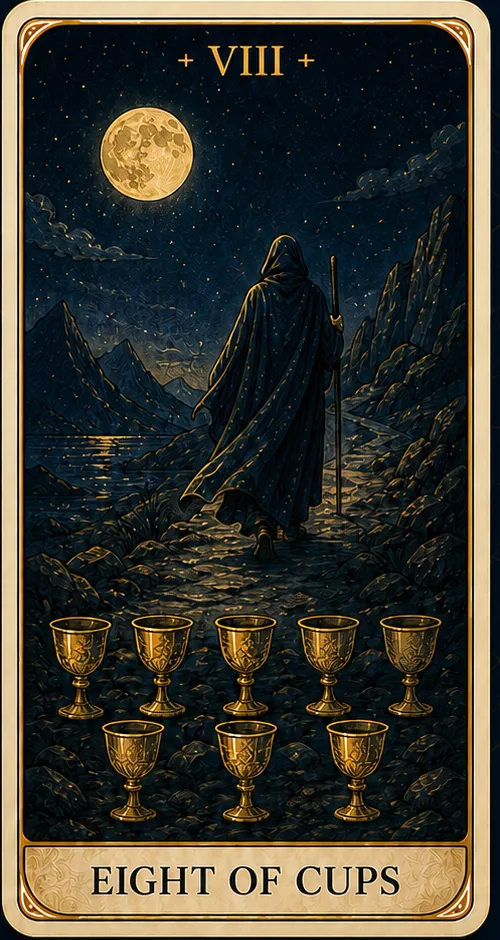
If a card feels difficult to interpret, describe it first. “There is a moon.” “The path curves out of sight.” “The figure seems to be waiting.” You do not need specialised language to pay attention to an image.
Then notice what drew you to that detail. Perhaps the path feels inviting. Perhaps the darkness reminds you of an unanswered question. Your response does not have to match anyone else’s reading.
A useful opening sentence is: The first thing I noticed was… Finish it without editing. If another sentence follows, give it room. If it does not, the observation can stand on its own.
Write a little, without performing
Try giving yourself three lines instead of a full page:
- Right now, I notice…
- This card brings to mind…
- Today, I would like to make room for…
You can be specific, uncertain, or ordinary. “I need a quieter lunch break” is just as valid as a larger realisation. The point is to hear yourself, not to produce an impressive account of your inner life.
Your reflection can be unfinished and still be worth keeping.
You are also allowed to keep some things unwritten. Thinking about a question on a walk or sitting with it for a moment can be part of the ritual too. Writing is an option, not a test of how seriously you are taking the practice.
Return with curiosity
When you revisit an older entry, try reading it as a record of one moment. You may no longer feel the same way. You may see something you could not name at the time. That does not make the earlier reflection wrong.
Look for patterns gently. Are you returning to a particular wish, question, or source of comfort? You do not need to label a few entries as a permanent truth about yourself. Your words have context, and you are allowed to change.
Know what you are choosing to save
In the Inner Draw app, the daily card is free. Saving the first reflection for a reading uses one credit; editing that saved reflection and reading existing Journal entries are free. The sample reading on this website does not save reflections or use credits.
Before you write, decide what feels right for this moment: a saved reflection, a private notebook, or a thought you simply carry with you. Each is a way of listening.
For a starting question, explore the Eight of Cups, or read about making space for a daily ritual.
Take a moment to try the Inner Draw ritual, or keep exploring the journal.